
Rebar Couplers for High-Rise Construction
From the raft to the roof, how mechanical splices keep heavily reinforced columns, cores and transfer structures buildable, strong and on programme.
High-rise buildings use rebar couplers because their columns, core walls, transfer slabs and rafts carry large-diameter, closely spaced bars where lap splices would cause congestion, waste steel and slow the pour cycle. Couplers give a full-strength, end-to-end splice, allow starter bars at construction joints, and meet ACI 318 Type 2 or seismic requirements where yielding may occur.
Why tall buildings need mechanical splices
As a building gets taller, the forces in its vertical elements grow and so does the reinforcement. Lower-level columns and core walls commonly use bars of 32 mm to 40 mm at tight spacing. A lap splice for those bars needs a long overlap. That doubles the steel at every splice level, blocks concrete flow and makes vibration difficult.
Less congestion
End-to-end splices keep bar spacing clear, so concrete can be placed and compacted properly.
Less steel
No overlap length. The saving grows with bar diameter and repeats on every floor.
Faster cycles
Pre-threaded bars and cast-in couplers speed up cage fixing on core and column pours.
Full-strength continuity
Type 2 couplers develop the bar’s specified tensile strength, which matters in yielding and seismic regions.
Where couplers are used, raft to roof
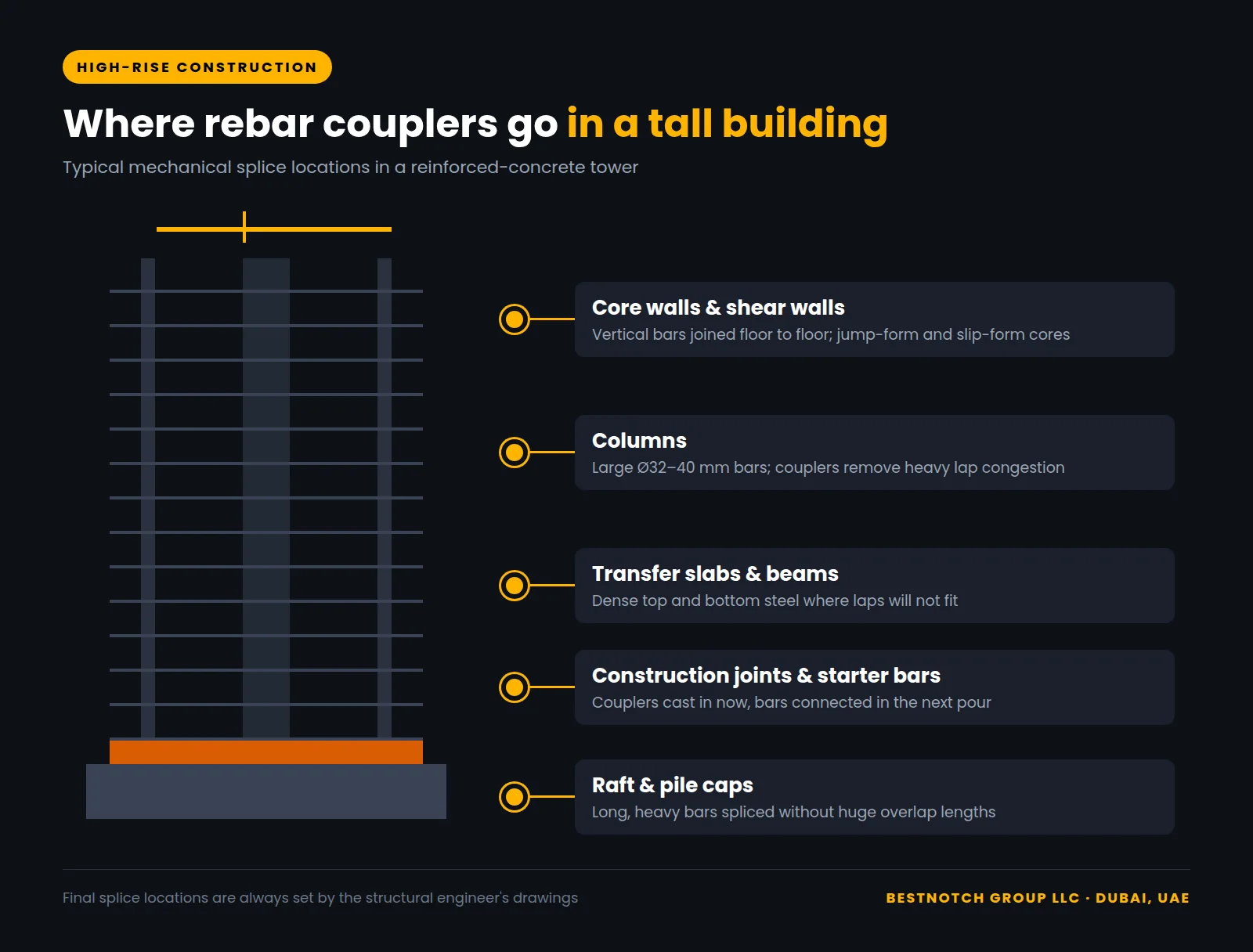
| Element | Why couplers | Typical coupler |
|---|---|---|
| Raft & pile caps | Very long, heavy bars; laps would add tonnes of steel | Parallel thread, transition |
| Columns | Large bars in tight cages; splice at each lift | Parallel thread, transition as bar size steps down |
| Core & shear walls | Jump-form and slip-form cycles; congested boundary zones | Parallel thread; positional where bars cannot rotate |
| Transfer slabs & beams | Dense top and bottom layers; heavy loads | Parallel thread, bolted for tight fits |
| Construction joints & wall-to-slab | Starter bars without drilling or protruding laps | Cast-in couplers with thread caps |
| Steel-to-concrete connections | Rebar joined to embedded plates and steel members | Weldable coupler |
Couplers in jump-form and slip-form cores
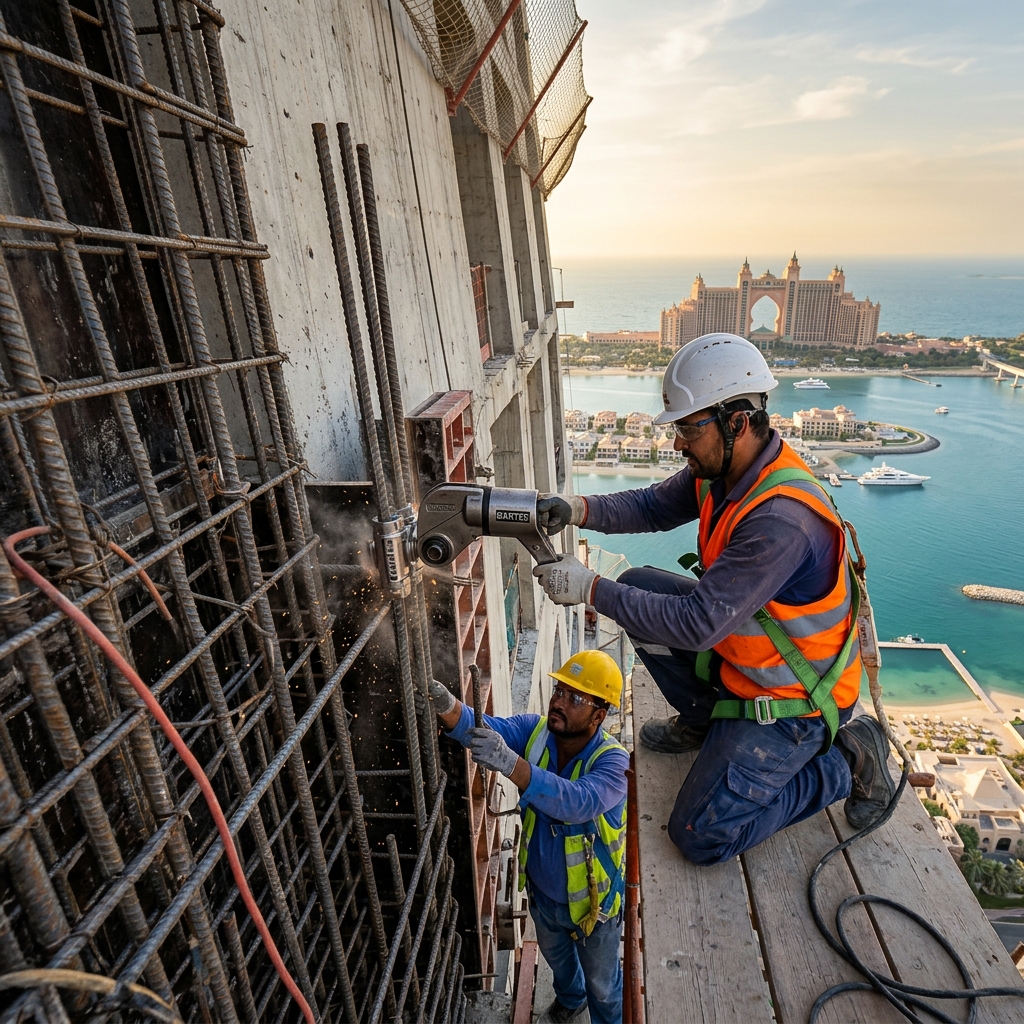
Core walls are usually built ahead of the floor slabs using climbing (jump) or slip formwork. Couplers help in two ways. Vertical bars can be spliced quickly at each lift, and horizontal slab or beam bars can be connected to the core later through cast-in couplers or coupler boxes left in the wall face. This avoids bending protruding bars out of the way, which is slow and can damage the bars.
Choosing the right coupler by situation
- Standard vertical splicesBoth bars free to rotate: parallel thread couplers give the best value at high volume.
- Bar size changesColumn bars stepping down with height: use transition (reducer) couplers.
- Neither bar can rotateCurved bars, cages already fixed or cast-in bars: use positional couplers or bolted couplers.
- Connection to steelEmbedded plates, steel columns or outriggers: weldable couplers.
- Precast and speed-critical workRepetitive precast elements: one-touch couplers.
Design and specification notes
- Type 1 vs Type 2: under ACI 318, Type 1 splices are not permitted within twice the member depth of a column or beam face in special moment frames, or where yielding is likely. Specify Type 2 there.
- Stagger: follow the engineer’s splice stagger. Do not put every coupler in one plane.
- Cover: the coupler’s outside diameter is larger than the bar, so check that concrete cover and bar spacing are measured to the coupler.
- Standards: projects in the UAE may cite ACI 318, BS 8110, EN 1992 and ISO 15835. Match the test evidence to the specification.
- QA: gauge threads, mark engagement and record each pour. See common coupler mistakes.
On a tower, the column and core cycle sets the pace of the whole frame. Pre-threading bars off site and delivering them bundled by floor and element keeps crane time and fixing time predictable.
High-rise couplers in the UAE and GCC
Dubai, Abu Dhabi, Riyadh and Doha continue to build tall residential, hotel and mixed-use towers. Contractors there value coupler suppliers who can deliver by floor sequence, back up approvals with documentation and support crews on site. Best Notch Group LLC, based in Dubai, supplies coupler systems for towers across the UAE, the GCC and worldwide. Talk to our engineers about your project.

Frequently Asked Questions
Why are rebar couplers used in high-rise buildings?
Tall buildings have large, closely spaced bars in columns, cores and transfer structures. Couplers splice them end to end without long overlaps. This reduces congestion and steel use, speeds up pour cycles and gives full-strength continuity.
Where are couplers used in a tower?
Typically in the raft and pile caps, columns, core and shear walls, transfer slabs and beams, construction joints (as cast-in starter couplers) and at steel-to-concrete connections.
Which coupler is best for high-rise columns?
Parallel thread couplers are the standard choice for vertical column splices. Transition couplers are used where bar size steps down with height, and positional couplers where neither bar can rotate.
Do high-rise buildings need Type 2 couplers?
Where bars may yield, such as near beam-column joints in special moment frames, ACI 318 requires Type 2 splices. Your structural engineer decides the locations. Many towers specify Type 2 throughout for simplicity.
How do couplers help core wall construction?
They let vertical bars be spliced quickly at each jump-form lift. Cast-in couplers in the wall face also let slab and beam bars connect later without bending protruding bars.
Can Best Notch supply couplers for towers outside the UAE?
Yes. Best Notch Group LLC supplies coupler systems from Dubai to high-rise projects across the GCC and worldwide, with delivery planned around the pour sequence.
Couplers for your next tower
Best Notch supplies parallel thread, positional, transition, weldable and bolted couplers for high-rise projects, delivered from Dubai with full documentation.