
ISO 15835 Rebar Coupler Compliance, Explained
What the international coupler standard actually requires, what B, F and S mean on a test report, and how to check a supplier’s ISO 15835 claim.
ISO 15835 is the international standard for couplers used to mechanically splice reinforcing bars. Part 1 sets requirements, Part 2 defines test methods and Part 3 covers conformity assessment. Couplers are classed as B (basic static), F (fatigue), S (seismic) or FS. Every class must meet limits on tensile strength, ductility and slip.
What is ISO 15835?
ISO 15835, Steels for the reinforcement of concrete: Reinforcement couplers for mechanical splices of bars, is the ISO standard that defines how a rebar coupler must perform and how that performance is proven. Many international specifications, European national annexes and Middle East consultants cite it as a neutral reference for coupler approval.
The current requirements edition is ISO 15835-1:2018. ISO has also registered a new revision project, so always confirm which edition your project specification names.
| Part | Title / focus | What it gives you |
|---|---|---|
| ISO 15835-1 | Requirements | Performance categories and pass/fail limits for strength, ductility, slip, fatigue and seismic behaviour |
| ISO 15835-2 | Test methods | How specimens are prepared and loaded, and how slip and elongation are measured |
| ISO 15835-3 | Conformity assessment | How many tests are needed and how factory production control is assessed |
The four coupler categories: B, F, S and FS
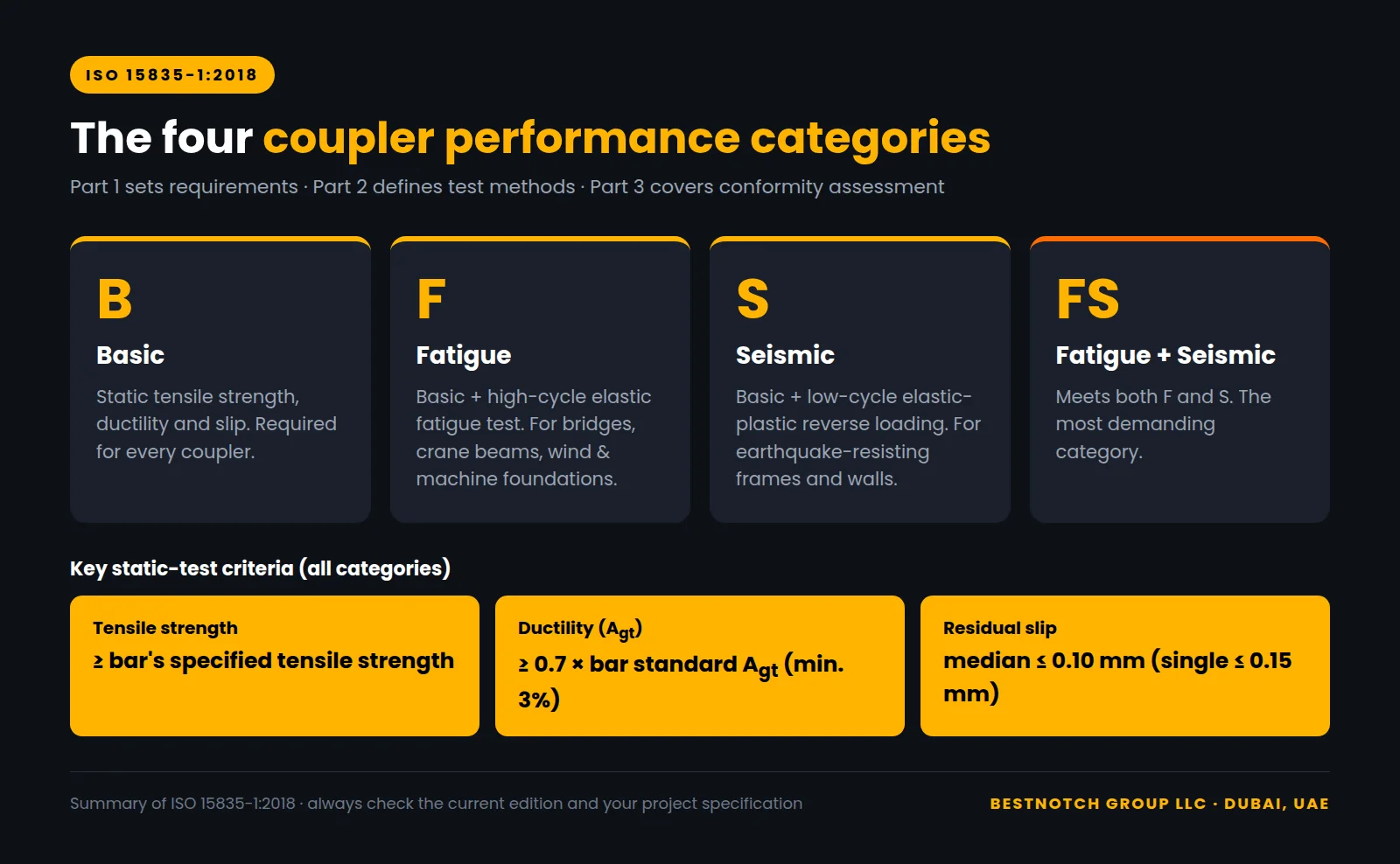
B: Basic
Static loading. Proves strength, ductility and slip. This is the minimum for any coupler under ISO 15835.
F: Fatigue
Adds a high-cycle elastic fatigue test. Relevant for bridges, crane girders, wind-turbine and machine foundations.
S: Seismic
Adds low-cycle elastic-plastic reverse (tension–compression) loading. Relevant for earthquake-resisting frames and walls.
FS: Fatigue + Seismic
Meets both dynamic requirements. Used for demanding infrastructure in seismic regions.
Key test requirements in plain English
For the static (Category B) requirements that apply to every coupler, ISO 15835-1:2018 checks three things:
- Tensile strengthThe spliced bar must reach at least the specified minimum tensile strength of the reinforcing bar. In practice the bar should behave as if it were continuous.
- DuctilityThe total elongation at maximum force (Agt), measured on the bar outside the coupler, must be at least 0.7 times the Agt required by the bar standard. If the bar standard sets no value, the minimum is 3%.
- SlipResidual slip across the splice after loading to a set stress must be small. The median value must not exceed 0.10 mm, and no single result may exceed 0.15 mm. Longer couplers (over 100 mm) have an adjusted limit.
A coupler that slips lets a crack open at the splice even when its strength is fine. Tight slip limits keep crack widths under service loads close to those of continuous bar, which matters for durability in the Gulf’s aggressive, chloride-rich environment.
ISO 15835 vs ACI 318 Type 1 / Type 2
Projects in the UAE and wider GCC often cite several standards at once. The table shows how the main references relate to each other:
| Standard | Coupler requirement | Typical use |
|---|---|---|
| ISO 15835-1 | Categories B / F / S / FS with strength, ductility, slip and dynamic tests | International and European-style specifications |
| ACI 318 Type 1 | Develops at least 125% of the bar’s specified yield strength (1.25 fy) | Non-yielding regions in US-code designs |
| ACI 318 Type 2 | Type 1 + develops the specified tensile strength of the bar | Required near yielding regions in special seismic frames |
| EN 1992 / BS 8110 | Refer to proven mechanical connectors; details set by national annex and project specification | Eurocode and legacy British-code projects in the Gulf |
A coupler can meet several of these at once, and good suppliers test to the strictest one in your specification. Read more on our standards and certifications page.
How to verify a supplier’s ISO 15835 claim
- Ask for the test report, not a logo. It should name the standard edition, the category (B, F, S or FS), bar sizes, bar grade and the test laboratory.
- Check the bar tested matches your bar. Results for B500B bars do not automatically cover a different grade or standard.
- Look for independent testing by an accredited laboratory or a third-party certification scheme, not only in-house results.
- Confirm factory production control and batch traceability (heat numbers linked to mill certificates).
- Plan site sample tests. Many consultants require a set of spliced specimens per size or per batch to be tested at a local accredited laboratory before approval.
For installation quality, which is the other half of compliance, see how to install rebar couplers and our list of common coupler mistakes.
Frequently Asked Questions
What is ISO 15835?
ISO 15835 is the international standard for reinforcement couplers used to mechanically splice steel reinforcing bars. Part 1 sets performance requirements, Part 2 sets test methods and Part 3 covers conformity assessment.
What do B, F and S mean in ISO 15835?
They are performance categories. B (basic) covers static strength, ductility and slip. F adds a high-cycle fatigue test. S adds low-cycle reverse loading for seismic use. FS meets both F and S.
What is the slip limit in ISO 15835?
Under ISO 15835-1:2018 the median residual slip across the splice must not exceed 0.10 mm, with no individual result above 0.15 mm. Couplers longer than 100 mm have an adjusted limit.
Is ISO 15835 the same as ACI 318 Type 2?
No. They are different standards with different test methods. ACI 318 Type 2 requires the splice to develop the bar’s specified tensile strength. ISO 15835 adds explicit ductility and slip limits and optional fatigue and seismic categories. A coupler can be tested to both.
Which ISO 15835 category do I need?
Your structural engineer or specification decides. Buildings under mainly static load usually need Category B. Bridges and fatigue-loaded structures need F. Earthquake-resisting elements in seismic zones need S, or FS where both apply.
Can Best Notch supply ISO 15835 test documentation?
Yes. Best Notch provides test certificates and mill traceability with its couplers for consultant submittals. Contact our Dubai team with your specification and we will confirm the matching documentation.
Specify couplers with the right test evidence
Best Notch supplies mechanical rebar couplers with batch test certificates and mill traceability for consultant approval, delivered from Dubai to projects worldwide.