
Rebar Coupler Price Guide UAE 2026: Costs, Drivers & ROI
Why two quotes for the “same” coupler can differ widely, what actually drives the price, and how to work out whether couplers beat lap splices on your project.
Rebar coupler prices in the UAE depend mainly on bar diameter, coupler type, performance grade (Type 1 or Type 2), order quantity and whether bar threading is included. A standard parallel-thread coupler is usually the lowest-cost option. Bolted and weldable couplers cost more. Against a lap splice, couplers typically pay back fastest on bars of 25 mm and above.
How rebar couplers are priced
A rebar coupler (a mechanical splice) is priced per piece, but the number on the quote is only part of the cost. It also has to cover the preparation of the bar ends, testing, logistics and the performance level your engineer has specified. For this reason a UAE buyer comparing quotations should always ask for an itemised price instead of a single unit rate.
For the same bar size, there are four common pricing models in the Gulf market:
- Coupler-only supply: you buy sleeves; the contractor threads the bars with its own or rented equipment.
- Coupler + threading service: the supplier threads bars at its yard or on site and supplies the sleeves.
- Coupler + equipment rental: the threading machine, dies and gauges are rented for the project duration.
- Package price per splice: one rate per completed joint including sleeve, threading and testing.
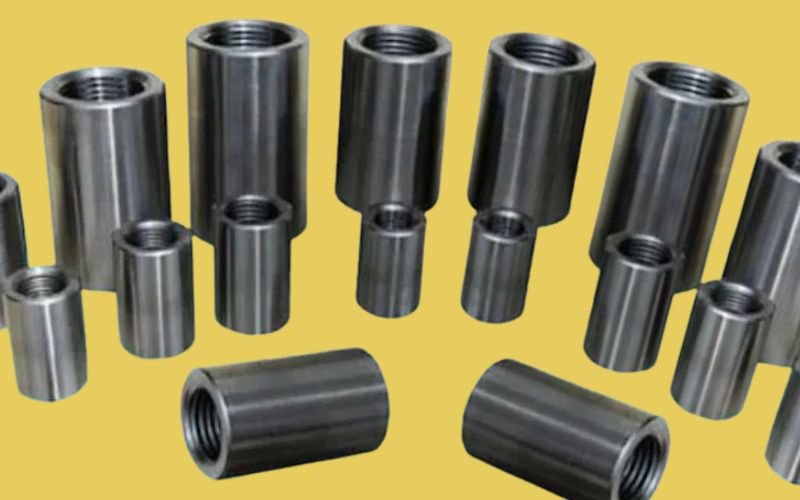
The 8 factors that drive coupler price
- Bar diameterA 40 mm coupler contains several times more steel than a 16 mm one and needs longer machining time. Price rises steeply with diameter.
- Coupler typeStandard parallel-thread sleeves are the simplest to make. Positional, transition (reducer), bolted and weldable couplers involve more parts or processing.
- Performance gradeA Type 2 (ACI 318) or seismic-category coupler must develop the bar’s full tensile strength, and that needs more testing and tighter quality control.
- Bar grade and standardCouplers have to match the rebar grade used, such as B500B to BS 4449 or Grade 60/75 to ASTM A615/A706.
- Quantity and repetitionLarge, repetitive orders for one or two sizes cost less per piece than small mixed batches.
- Bar-end preparationThreading on site or in a yard, rental of machines and dies, and operator labour. This is often the item left out when comparing quotes.
- Testing and documentationProject-specific tensile tests at an accredited laboratory, mill certificates and traceability records.
- Delivery and lead timeFreight, packing, and any urgent air shipment to meet a pour date. Imported product may also carry duties.
Ask every supplier to quote the same scope: couplers, threading, testing and delivery as separate lines. A cheap sleeve with expensive threading or re-testing is not a cheap splice.
Relative cost by coupler type
Unit prices change with steel markets and order size, so the table compares the relative cost of each system. It also shows where each one earns its price.
| Coupler type | Relative unit cost | Extra site cost | Best value when… |
|---|---|---|---|
| Parallel thread | $ (lowest) | Bar threading | High volumes of standard column, wall and slab splices |
| Pressed (swaged) | $$ | Hydraulic press on site | No threading possible; confined areas |
| One-touch | $$ | Minimal | Speed matters most: precast and repetitive work |
| Weldable | $$ | Certified welding | Connecting rebar to structural steel members |
| Bolted | $$$ (highest) | Torque wrench only | Retrofit and repair; bars that cannot rotate |
Transition couplers (joining two different bar sizes) and positional couplers (where neither bar can rotate) usually cost more than the standard sleeve of the same diameter. Plan for them separately in your bill of quantities.
What a lap splice really costs in steel
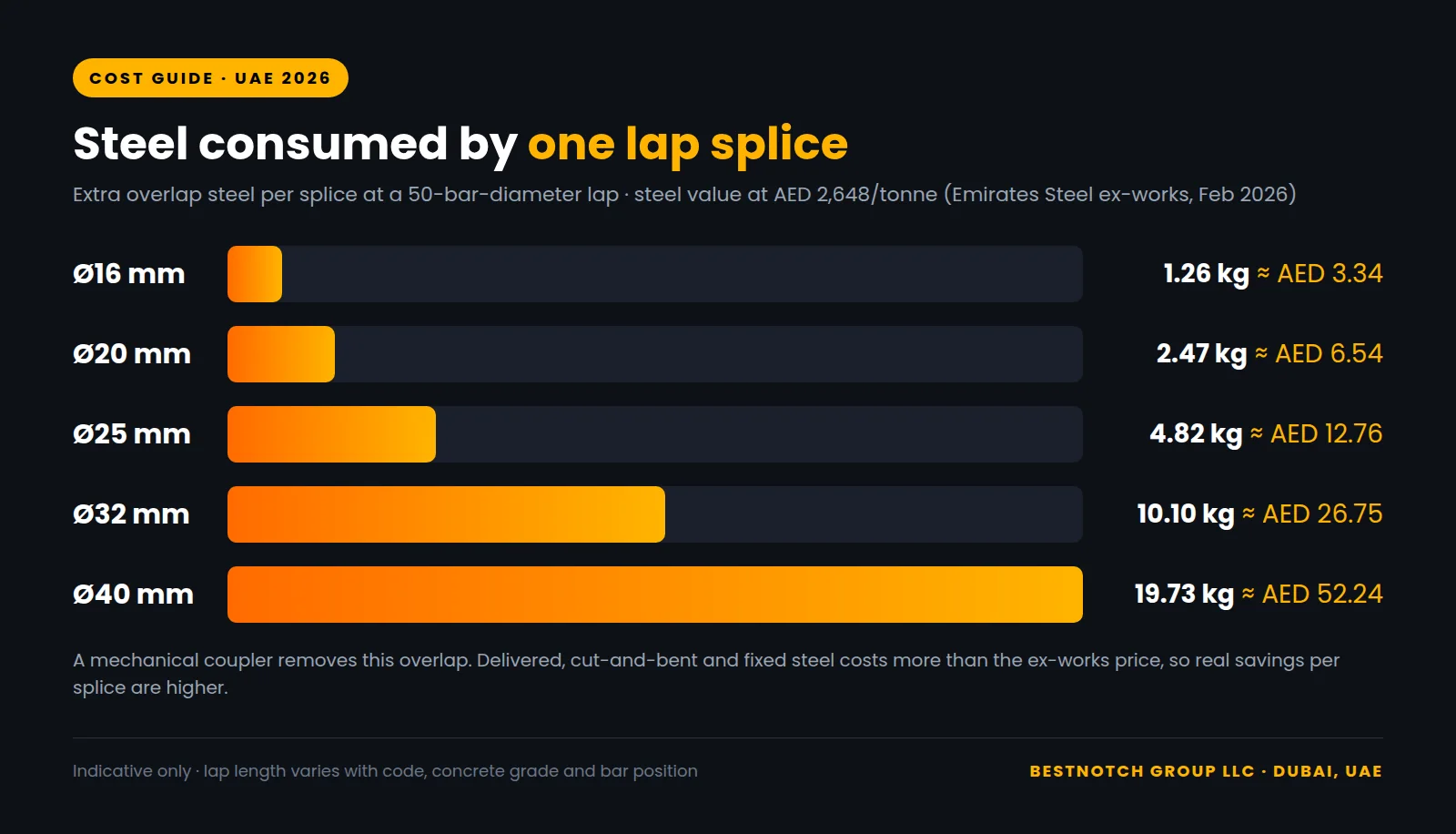
Lap splices look free because they need no coupler. They are not free: every lap adds an overlap of extra bar, and on large diameters that steel quickly costs more than a coupler. The chart uses a 50-bar-diameter lap for illustration, and Emirates Steel’s announced ex-works rebar price of AED 2,648 per tonne for February 2026.
| Bar Ø | Lap length at 50Ø | Extra steel per lap | Steel value (ex-works) |
|---|---|---|---|
| 16 mm | 0.80 m | 1.26 kg | ≈ AED 3.34 |
| 20 mm | 1.00 m | 2.47 kg | ≈ AED 6.54 |
| 25 mm | 1.25 m | 4.82 kg | ≈ AED 12.76 |
| 32 mm | 1.60 m | 10.10 kg | ≈ AED 26.75 |
| 40 mm | 2.00 m | 19.73 kg | ≈ AED 52.24 |
Required lap length depends on the design code, concrete grade, bar position and whether bars are in tension or compression. Your engineer’s lap schedule gives the real figure. The method stays the same: lap length × bar mass per metre × installed steel rate.
When couplers pay back: a simple ROI method
Use this three-step check on any element, such as a column schedule or a core wall:
- Cost per lap = lap length × kg/m of the bar × your installed steel rate (AED/kg, including cut, bend, deliver and fix).
- Cost per coupler splice = coupler price + threading cost per bar end ×2 + a share of testing.
- Add the hidden savings of couplers: less congestion (better concrete compaction), faster cage fixing, and shorter cycle times on core and column pours.
On most UAE projects the result follows a clear pattern. For small bars (≤ 16 mm) laps are often cheaper. For 25 mm and above, especially in columns, core walls and transfer structures, couplers usually cost less overall. In seismic-designed or heavily congested areas the engineer may specify mechanical splices whatever they cost. Read our coupler vs lap splice comparison for the full cost model.
How to get an accurate quotation
You will get faster and more comparable prices if your enquiry includes:
- Bar diameters and approximate number of splices per size
- Rebar grade and standard (for example BS 4449 B500B)
- Required performance (ACI 318 Type 1 or Type 2, BS 8110 / EN 1992, ISO 15835 category)
- Any transition, positional or weldable connections
- Whether you need threading, equipment rental or both
- Project location and your first pour date
Best Notch Group LLC supplies all five coupler systems from its head office in Dubai. We quote couplers, threading support and certification separately, so you can compare like for like. Request a quotation or see the full coupler range.
*Emirates Steel announced ex-works rebar price for February 2026 production (AED 2,648/t), as reported by the Arab Iron and Steel Union. Steel prices change monthly, so check the current rate before you calculate.
Frequently Asked Questions
How much does a rebar coupler cost in the UAE?
There is no single price. Cost depends on bar diameter (16–40 mm), coupler type, performance grade, quantity and whether threading is included. Standard parallel-thread couplers are the lowest-cost option, and bolted couplers the highest. Ask for an itemised quote covering couplers, threading, testing and delivery.
Are rebar couplers cheaper than lap splices?
On small bars, lap splices are usually cheaper. From about 25 mm upward, the overlap steel a lap consumes (about 4.8 kg per 25 mm lap and 10 kg per 32 mm lap at a 50Ø lap length) plus fixing labour usually costs more than a coupler splice.
Why do coupler quotations vary so much?
Quotes often cover different scopes. One may include threading, equipment and test certificates while another quotes the sleeve only. Performance grade (Type 1 or Type 2), size mix, quantity and lead time also change the unit price.
Does a Type 2 coupler cost more than Type 1?
Usually yes. A Type 2 (ACI 318) coupler must develop the bar’s specified tensile strength, not just 125% of its yield strength. That needs stricter manufacturing control and more testing, but Type 2 is required in many seismic and yielding regions.
What information do I need to get a coupler price?
Bar sizes and quantities, rebar grade, the required standard or coupler type, any transition or positional splices, whether you need threading support, the site location and the required delivery date.
Does Best Notch deliver couplers outside the UAE?
Yes. Best Notch Group LLC supplies mechanical rebar couplers from its head office in Dubai to projects across the GCC and worldwide, with test certificates and export documentation.
Get an itemised coupler quotation
Share your bar sizes, quantities and specification. Best Notch will reply with a clear quote covering couplers, threading support, test certificates and delivery. Head Office: Dubai, UAE, supplying projects worldwide.